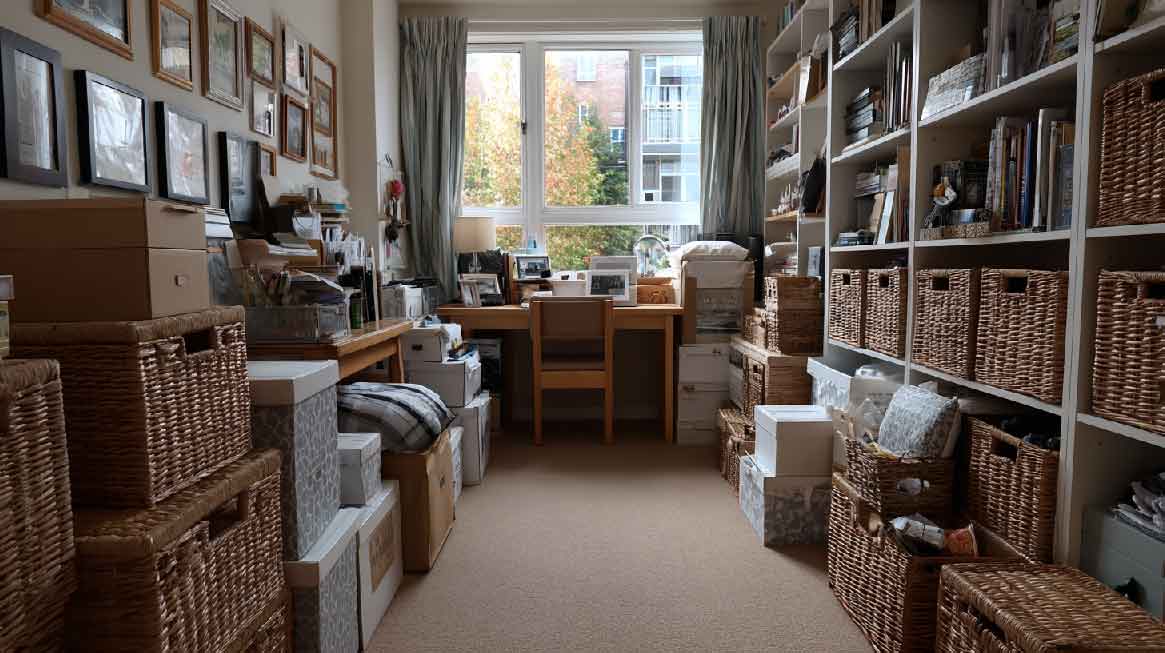
To declutter a small London flat, work through one zone at a time, keep what you use or would pack for your next move, give everything a fixed home, and clear floors and worktops first. With fewer things on surfaces, every clean gets quicker, because the time goes on cleaning instead of moving things around.
Why does decluttering make cleaning faster?
Every object on a surface adds three steps to cleaning it: lift it, wipe underneath, put it back. A bathroom shelf holding fifteen bottles takes minutes to clean, and an empty one takes seconds. A clear floor can be vacuumed in one continuous pass, and a robot vacuum works far better when cables, shoes and bags are out of the way.
Bathroom clutter also makes its own work in a hard-water area. Thames Water, the supplier for much of the capital, calls the water in its region hard throughout (Thames Water), and bottles left on a bath edge sit in water that dries into limescale rings. If you pay for cleaning, every minute a cleaner spends moving piles is a minute not spent on the bathroom or the hob.
Where should you start decluttering a small flat?
Start with the surfaces that get cleaned most often: the kitchen worktop, the bath edge, the hallway floor and the bedroom floor.
- Pick one zone and set a 20-minute timer. One drawer, shelf or corner is enough.
- Use four bags or boxes: keep, donate or sell, recycle, and rubbish, plus a basket for things that belong in another room.
- Empty the zone and clean it before anything goes back.
- Put back only the keep pile, and give each item a home it always returns to.
- Get donations out of the flat within a week. A donation bag left in the hallway is just clutter in a new place.
How do you decide what to keep in a small space?
With no loft, garage or spare room, everything competes for the same few cupboards. Ask yourself:
- Have I used it in the last year? Seasonal things, such as a winter coat or a desk fan, count if you used them last season.
- Would I pack it for my next move? If you rent, picture wrapping it up on moving day. If you would leave it behind then, let it go now.
- Is it waiting to be repaired? Give repairs a one-month deadline, then recycle it or pass it on.
- Is it sentimental? Keep it, but give sentimental things one box rather than a whole cupboard.
For paperwork, if you send a Self Assessment tax return on time, GOV.UK says to keep your records for at least 22 months after the end of the tax year the return is for, and longer if you are self-employed (GOV.UK). Scan what you need, and shred anything with your name, address or account details before it goes in the recycling.
What should you clear in each room?
- Kitchen: leave only daily-use appliances on the worktop, clear out-of-date food and half-used packets, match every food container with a lid, and keep only as many mugs as you use between washes.
- Bathroom: rinse and recycle empty bottles, keep only daily products on the bath or shower edge, and throw out old make-up and worn razors. Take unwanted medicines to a pharmacy: NHS North East London says you can return unused medicines to your local pharmacy for safe disposal (NHS North East London).
- Bedroom: take out clothes you have not worn for a year or that no longer fit. Turn every hanger the same way, and after a season, anything still hanging the original way is a candidate to go.
- Hallway and living room: keep only this week's shoes by the door, give keys and post one landing spot, and gather old cables and chargers for an electricals drop-off point.
Which storage ideas work in a small London flat?
Closed storage that keeps things off floors and surfaces makes the biggest difference, and it gathers less dust than open shelving.
- Go vertical. Tall bookcases, wall shelves and over-door hooks use the height of the room. If you rent, check your tenancy agreement and ask your landlord before drilling.
- Use the space under the bed. A bed frame with drawers, or lidded boxes on castors, will hold spare bedding and out-of-season clothes.
- Leave a gap behind furniture. Government guidance on damp and mould advises leaving a gap between furniture and external walls. A wardrobe pushed flat against a cold outside wall can hide mould, so check behind big furniture every few months.
How do you declutter in a flat-share?
Start with your own room and your own things, and ask before clearing anything in a shared space that might belong to a housemate. Furniture and kitchen items listed on the inventory belong to the landlord, so leave those where they are. Agree one kitchen cupboard and one bathroom shelf per person.
When you move, everything you brought in must go before the check-out inspection. Our move-out cleaning timeline and end of tenancy cleaning checklist cover the clear-out and the final clean.
Where can you donate, sell or recycle things in London?
The right route depends on the item, and rules and charges differ between London boroughs, so check your council's website first. You can find it by postcode on GOV.UK.
- Furniture in good condition. Some charities collect furniture for free. The British Heart Foundation, for example, checks your postcode to see whether it collects in your area. Sofas, mattresses and padded chairs need their fire safety label attached, because by law the charity cannot sell upholstered furniture without one (BHF).
- Large items nobody wants. Councils run bulky waste collections for things such as sofas, mattresses and fridges. Some boroughs charge for every collection and some include a few free ones, so read your own council's page before you book.
- Electricals and batteries. Never put them in the household bin. Material Focus, the charity behind the Recycle Your Electricals campaign, warns that hidden batteries inside electricals can start fires when they are crushed in bin lorries and recycling centres, and its postcode locator lists drop-off points. When you buy a new appliance, the shop must also offer a way to dispose of your old one of the same type (GOV.UK).
- Clothes, books and homeware. Charity shops take clean items in good condition.
How do you keep a small flat clutter-free?
- One in, one out. A new jumper means an old one goes in the donation bag, which lives in the wardrobe until it is full.
- Say no to freebies. Promotional tote bags, free samples and spare takeaway cutlery are how small flats fill up.
- Reset surfaces every evening. The five-minute tidy in our daily cleaning routine stops new piles forming.
Should you book a deep clean after decluttering?
Straight after a big clear-out is the best time for one. Cupboards are empty and surfaces are bare, so a deep clean can reach the inside of cupboards, the tops of wardrobes and the space behind furniture without working around your belongings. SW Clean London charges £23 per cleaner per hour for deep cleaning, 3 hours minimum, with products and equipment included. A 1 bedroom flat typically takes 4–6 hours. After that, our weekly cleaning checklist helps you keep it that way.
Frequently asked questions
Should I declutter before a cleaner comes?
Yes, at least the surfaces and floors. A cleaner can only clean what they can reach, so clothes on the floor, papers on the table and bottles around the bath all take time away from the cleaning itself. You do not need a perfect flat. Ten minutes putting things away before the visit is usually enough to make the paid time count.
How often should you declutter a small flat?
Do one big clear-out, then keep it going with small sessions. After the first full pass, fifteen minutes on one zone each month keeps most small flats under control, with a bigger review when the seasons change and you swap your clothes over. Moving home is the other natural moment, because every item has to be handled anyway.
What can I do with things I cannot donate or sell?
Recycle what you can through your council's household collections and its recycling centre, and book a bulky waste collection for large items. Take electricals and batteries to a drop-off point, never the bin, and medicines back to a pharmacy. For anything unusual, search your council's website for the item.
Cleared out and ready for a fresh start? Book a deep clean online and get the price confirmed before the clean.